ALPR Surveillance
St. Louis Park's license plate cameras were pulled into nationwide immigration searches, and a Texas abortion case
The city's own Flock Safety records show outside agencies searched its cameras for immigration enforcement 2,637 times, and once for a woman who had an abortion. St. Louis Park says it has since blocked such searches, and points to serious cases the cameras helped solve when justifying their use.
St. Louis Park, Minnesota, pays the surveillance company Flock Safety to operate 16 cameras on its busiest streets. The cameras photograph every passing license plate, record the time and location, and upload the data to Flock's servers. For most of the history of policing, police records stayed local; an outside agency that wanted access had to call and explain why. Flock changed that. By default, its system makes a city's cameras searchable by thousands of other police agencies nationwide, from local departments to federal officers.
That reach cuts both ways. The same network that helps police recover a stolen car or find a missing child also lets agencies across the country search local residents' movements, for reasons the city opposes or under laws that do not apply there. St. Louis Park is the prime example. Between January 2025 and April 2026, outside agencies ran thousands of immigration searches against the city's cameras during the most aggressive federal immigration crackdown the state had ever seen, one that killed two U.S. citizens in the Minneapolis area, wounded a third, and led to assault charges against an ICE agent. A Texas deputy also searched the cameras for a woman who "had an abortion," a procedure that has been legal in Minnesota since the state codified abortion rights in 2023. St. Louis Park's own police ran no immigration searches across 16 months of logs, and the city told FinePrint the searches "did not align with the values of the City of St. Louis Park and the St. Louis Park Police Department." Flock's default settings let other agencies run them anyway, and the city restricted access only after the problems had repeatedly surfaced.
The audit logs FinePrint obtained through a public records request show 2,637 searches tied to immigration enforcement, run by 134 different agencies, about 95 percent of them based outside Minnesota. Of those, 1,331 were flagged as the work of Homeland Security Investigations, the investigative arm of ICE, and 829 were tied to ICE itself. A single Michigan department, the Grand Rapids police, ran 105 deportation-warrant lookups over three and a half months of access, from early February to mid-May 2025. Asked about the findings, the city said the searches were nationwide sweeps that did not target St. Louis Park, and that they did not reflect the city's values.
In December 2025, the Trump administration sent roughly 3,000 ICE and Customs and Border Protection agents into the Minneapolis-St. Paul area for what the Department of Homeland Security called its largest immigration operation ever. Over the weeks that followed, federal agents killed two U.S. citizens, Renée Good and Alex Pretti, and wounded a third. A Hennepin County prosecutor later charged an ICE agent with assault over that non-fatal shooting. The operation, named Operation Metro Surge, ran through the same period that outside agencies were searching St. Louis Park's cameras. The city sits squarely inside the area targeted by Metro Surge.
Safer, at what cost
The cameras do catch criminals, and the city provided FinePrint with case information to show it. St. Louis Park said that in under three years its Flock cameras had alerted officers to 159 stolen plates, 188 stolen vehicles, 488 outstanding warrants, and 18 missing persons. The city credited Flock data with finding a nine-year-old in November 2025 whom family believed had been kidnapped and held for ransom; the child was located safe. It cited a January 2026 case in which a suspect in a criminal-sexual-conduct investigation, who appeared to be seeking new victims, was arrested after being tracked across St. Louis Park and neighboring cameras.
The system works in two modes. A hotlist holds specific plates police are looking for, stolen cars, wanted suspects, missing children, and the cameras raise an alert the moment one passes. But the cameras also photograph and log every other vehicle, whether or not anyone is looking for it, and store each of those records in Flock's database, where the second mode, lookup, lets an officer search them later. Minnesota law caps that storage at 60 days; St. Louis Park holds its data for 30. The hotlist is targeted police work. The second mode — automatically capturing, logging, and storing the license plate, time, and location of every other car, whether or not anyone is looking for it — is what civil liberties advocates call mass surveillance.
Those cases are what makes the tradeoff hard. A curfew makes a neighborhood safer at night, but it takes away freedom. Mass surveillance works the same way. A database of everyone's movements can help police catch a criminal in one case and, in another, expose a driver to a law that does not apply where they live: abortion is legal in Minnesota but was under investigation in Texas, and Minnesota bars its own police from using plate data for immigration enforcement while agencies in other states operate under no such limit. Laws differ across the country and change over time; the record of who drove where does not. The tool does not change. Only the target does. St. Louis Park's cameras were built to flag stolen cars and solve local crimes. In the records, they were also used to help federal agents pursue immigration cases the city opposes, and to help a Texas sheriff look for a woman who had ended a pregnancy.
Built to share
The reason one city's cameras can be searched by police in more than a dozen states comes down to how Flock is set up out of the box. A November 2025 independent audit of another Minnesota Flock customer, the Paul Bunyan Drug Task Force, laid out that Flock's default settings automatically make every law enforcement agency "discoverable" to every other one and automatically "opt-in" to data sharing, meaning a department's cameras are shared with others unless someone turns the sharing off. That same task force has itself searched St. Louis Park's cameras.
The auditors raised two concerns about how the sharing works. When it is on, Flock lets one officer search the data of every agency that has agreed to share, all at once, which the auditors said may run afoul of a Minnesota law that bans any "central state repository" of license plate data. And the system keeps no record of who downloads data, so there is no way to know what leaves it. The Paul Bunyan task force had turned the master sharing switch off and approved outside agencies one by one. St. Louis Park eventually did the same, but only after thousands of searches the city now says did not align with its values.
Reading the logs
The records are Flock's own audit logs, released by the St. Louis Park Police Department in response to a public records request filed through MuckRock. They come in two parts: a log of searches the city's own officers ran, and a network audit showing every outside agency that searched the city's cameras. FinePrint reviewed 32 of these files, covering January 2025 through April 2026, and counted the searches whose stated reason pointed to immigration enforcement. Those reasons are typed in by the searching officer, not verified by Flock or the city, and many carried no case number. The code used to pull those numbers is public, and the city's current list of sharing partners is posted on its Flock transparency portal.
Immigration-related searches were a small fraction of the network's traffic, which ran to hundreds of thousands of searches a month before the city restricted access. What stands out is not their volume but their reach: out-of-state and federal agencies querying the cameras of a city whose own police refuse immigration work. The searches of St. Louis Park's cameras fell into three distinct phases.
Open to the whole country
For the first half of 2025, the network was effectively open to the entire country. In January, police in more than 15 states ran immigration-related searches on St. Louis Park's cameras. Hennepin County, the county St. Louis Park sits in, ran two searches on January 31 marked as urgent requests for Homeland Security Investigations. Oklahoma City logged an ICE-warrant search on January 7, two weeks before the second Trump administration took office.
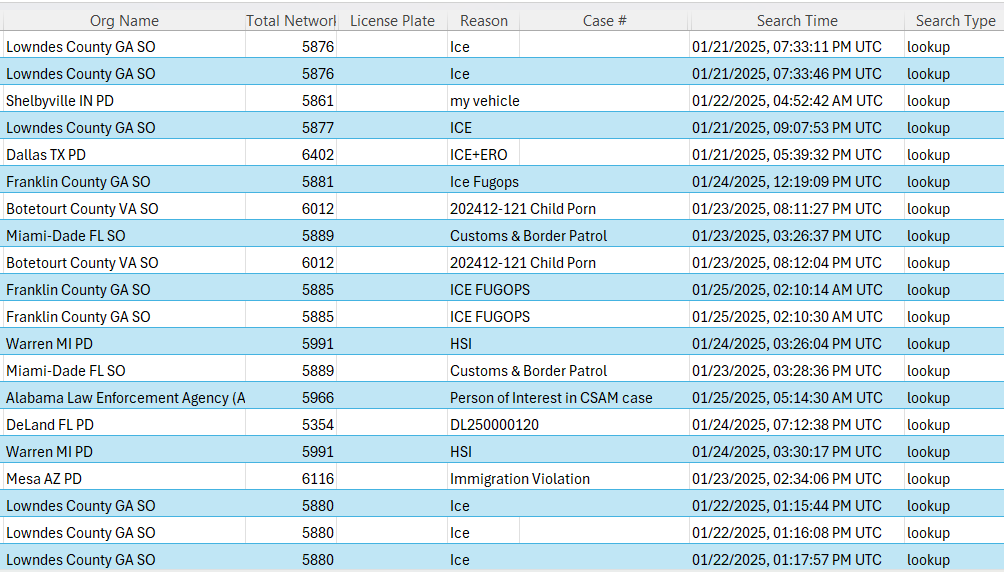
The pace picked up through the spring. April was the peak, with 989 immigration-related searches in that month alone. One Illinois department, the West Chicago police, accounted for 458 of them, each logged with a single word, "HSI," and most with no case number, roughly 15 searches a day for the entire month. Florida Highway Patrol logged searches naming ICE, HSI, and the Secret Service. The Grand Rapids police in Michigan accounted for all 105 of the deportation-warrant searches in the records. Six of the accounts that searched the cameras have since been deactivated, including two federal ATF offices and a Homeland Security Investigations account; together they ran 104 searches on cameras paid for by St. Louis Park.
The city stresses that these were nationwide searches that swept in St. Louis Park's cameras, not searches aimed at the city. That is largely true, and it is also the point. The cameras were reachable in those national dragnets because the city had left Flock's default sharing turned on, which made its data searchable by any agency on the network. Being in the national pool was a setting, not an accident, and to a resident whose car was logged, the difference between a targeted search and a nationwide one is indiscernible.
The reach went beyond immigration. On May 9, 2025, St. Louis Park's network was among thousands swept up in a single search out of Johnson County, Texas, logged with the reason "had an abortion, search for female." EFF later established that the search, first reported by 404 Media, was part of a death investigation into the woman's self-managed abortion, not the welfare check the sheriff and Flock had described in public. That one search reached 6,809 camera networks and more than 83,000 cameras across the country. St. Louis Park's were among them.

A leaky patch
In June 2025, the searches slowed sharply. After department staff saw national news reports of immigration searches on Flock networks and complained to the company, Flock pulled Minnesota agencies out of nationwide search, the city said, and St. Louis Park began requiring outside agencies to sign a data-sharing form. Network searches of its cameras fell from about 248,000 in a month to roughly 7,000, a 97 percent drop. The city believed those steps would end the immigration searches, because Minnesota law gives state agencies no authority to use plate readers for civil immigration enforcement.
The law had a gap. Under 287(g) agreements, federal contracts that deputize local officers to enforce immigration law, a Minnesota agency could claim federal authority that state law does not reach. "The use of 287g agreements to circumvent that state law was unanticipated at this time and was addressed in 2026," the city told FinePrint. Immigration-labeled searches kept appearing. Then, on October 31, 2025, a Missouri drug task force based in Brookfield ran two searches of the city's cameras with the reason "ICE detainer," months after Missouri agencies were supposed to have lost access entirely. Flock attached a note saying a software bug had let the search reach cameras the user was not authorized to see, and that it had fixed the bug. Asked about it, the city said it could not confirm whether Flock had ever notified it, and that it did not consider the search unauthorized access or a data breach, but "a legal inquiry." Flock's own note describes access the Missouri task force was not authorized to have.
The sharing form itself asks less than it might seem to. FinePrint obtained a copy signed in January 2026 by the Beltrami County Sheriff's Office, the Paul Bunyan task force member agency. It is one page. The requesting agency self-certifies that data use will be "restricted to active criminal investigations in compliance with law," that reason and case-number fields "must be fully completed" for every search, and that data will not be disseminated "except as permitted by law." Nothing in it names immigration or reproductive-health searches, and nothing in it stops an agency from lawfully passing results to federal partners; sharing that is permitted by an agency's own law is, by the form's terms, permitted. Enforcement is revocation after the fact. As for the mandatory case numbers: of the 2,637 immigration searches in the records, not one carried a case number in the audit fields; 2,476 were blank and 161 showed only asterisks.
St. Louis Park's form also has a notable omission. Nearby South St. Paul uses nearly the same one-page form, and a copy FinePrint obtained, signed in June 2026, includes something St. Louis Park's does not: a rule that its camera data cannot be used for immigration enforcement or handed to federal immigration authorities without a court order. St. Louis Park's form says nothing about immigration; the city has tried to block those searches through the system's settings instead. A setting can be worked around, or simply left unlabeled, by an officer who runs the same search without typing the word immigration. A rule written into the agreement itself carries a consequence: misuse can cost an agency its access.
Going quiet (on paper)
After June, the immigration searches kept running, increasingly stripped of any label that revealed them.
One outside player kept showing up: MOCIC, the Mid-States Organized Crime Information Center, a regional intelligence-sharing hub, or "fusion center," whose member states include Missouri, Illinois, Indiana, Iowa, Kansas, Kentucky, Nebraska, North Dakota, South Dakota, and Wisconsin. Before the restriction, MOCIC had run searches it labeled "Immigration Inv" in March and "IMMIGRATION VIOLATION" in June. Afterward, it kept running hundreds of searches a month but stopped labeling any of them as immigration-related. The records do not show whether MOCIC kept its access on purpose or by oversight.
Then the labels changed for everyone. Late in 2025, Flock replaced the open text box where officers typed the reason for a search with a fixed dropdown menu. The menu still includes an immigration category, but the agent names, operation titles, and case numbers that used to appear are largely gone. In the months after the change, the most common flagged reason in St. Louis Park's logs became "City Planning/Traffic Analysis" with an empty detail field, more than 440 such searches, a handful of them annotated only "DTF."
The change was immediate. In January 2026, the Mille Lacs County Sheriff's Office, in a rural county of about 26,000 people, ran 10 searches in the immigration category, eight of them on January 16, as Operation Metro Surge was underway. The detail fields were blank. Crow Wing County ran one more the next month and typed "HSI" into the text box, one of the few entries after the change that still named a federal connection. The searches kept coming, now stripped of the details and case numbers that revealed their purpose.
Same failures, different responses
St. Louis Park offers one detailed look at a national system, one whose default settings favor broad sharing and whose problems tend to surface the same way: through audits and public records requests, not through the company.
The closest parallel is Mountain View, California. After a public records request from the Mountain View Voice, the police there discovered that a "nationwide lookup" setting had been switched on for one of its cameras for several months in 2024, opening it to federal agencies, and that a "statewide" setting had let any California agency search 29 of its 30 cameras from the day they were installed. More than 250 agencies the city had never approved had searched its data. Flock kept no record of what the federal searches pulled. The police chief said he had lost confidence in the company and shut all 30 cameras off; the city council later voted to cancel the contract. In Dayton, Ohio, an audit found more than 7,000 immigration searches on a network whose own policy forbade them. Unable to cancel the contract quickly, the city covered its cameras with trash bags.
The broader numbers are large. The Electronic Frontier Foundation analyzed more than 12 million Flock searches run by over 3,900 agencies between December 2024 and October 2025. It found more than 80 agencies that used anti-Romani slurs in the reasons they typed for searches, and more than 50 that ran searches tied to lawful protests, some labeled simply "protest." The group also identified a built-in path for immigration enforcement: the FBI's national crime database carries an "Immigration Violator" list maintained only by ICE, covering plates linked to administrative warrants that no judge has reviewed, and Flock lets agencies subscribe to it through a dropdown. By the middle of 2026, dozens of cities had canceled or suspended their Flock contracts.
A vendor under scrutiny
The same stretch brought a series of security failures, most of them uncovered by the technology news site 404 Media. Researchers found at least 60 Flock cameras streaming live to the open internet with no password required, and showed that a camera on a public pole could be taken over in under 30 seconds using a button sequence on the device. 404 Media also found Flock login credentials in malware infections and for sale on a Russian cybercrime forum. The reporting prompted Senator Ron Wyden and Representative Raja Krishnamoorthi to ask the FTC to investigate the company for failing to require basic two-factor login security.
The system's access controls tend to fail toward more sharing. In one case 404 Media reported, first identified in Flock audit logs by FinePrint and shared with the outlet, a DEA agent used an Illinois detective's Flock login, without the detective's knowledge, to run immigration searches, in a state where using license plate data for immigration enforcement is illegal. Flock has also been expanding its surveillance capabilities. 404 Media reported on a new product called Nova, built to link a license plate to a named person using data brokers and public records, which an EFF analyst called the kind of "dystopian panopticon" the group had long warned about. Flock later said Nova would not use dark-web or breached data.
The mass surveillance debate
The city pushes back on the label of mass surveillance. "ALPRs alone don't create a searchable record of people's movements," it told FinePrint. The cameras, the city said, collect only a plate number without a state, a photo of the vehicle, and the date, time, and location, and none of it is tied to a person until a police case connects a plate to an investigation. Searches, the city noted, require a case number and a plate or vehicle description under state law, and the data is deleted after 30 days, sooner than the law requires.
The Supreme Court confronted nearly the same argument three weeks ago. In Chatrie v. United States, decided in June, police had used a geofence warrant to make Google identify every phone near a Virginia bank robbery. Google's process was built on the same premise the city invokes: it first handed over anonymous account identifiers, and investigators needed further judicial approval to unmask the names behind them. The court ruled 6-3 that even that anonymized location data is protected by the Fourth Amendment, with Justice Elena Kagan writing that a person has a reasonable expectation of privacy in records of their location, and that even a short window of it can expose visits to "the psychiatrist, the plastic surgeon, the abortion clinic."
A license plate is a weaker shield than the identifiers in Chatrie. It is a persistent, unique number that maps to a registered owner, and unmasking it requires no judge at all, only a DMV query or a commercial data broker such as CLEAR or Accurint. A plate reader builds the same kind of location trail the court just protected, from a place to the people who passed through it, or from a person to everywhere they drove, with none of the judicial oversight. And the records show the system used to find specific people: the ICE detainers, the deportation warrants, the abortion search.
There is a simpler test. St. Louis Park's police would not, by the city's own account, look up a license plate to help federal agents build a civil immigration case; state law forbids it, and the city says it clashes with its values. Yet for most of a year, its cameras answered thousands of those queries automatically, because the sharing was on and no one had to pick up the phone to justify a search. Responsible surveillance anticipates how a tool can be abused and builds the guardrails before deploying it. St. Louis Park built them after.
Fixed after the fact
To the city's credit, it did act, in two rounds, each after the misuse had already surfaced. The June 2025 measures, contacting Flock and requiring a sharing form, came first and left the 287(g) route open. In April 2026, after a City Council study session and community pressure, the city cut off access to any agency with a 287(g) agreement, began quarterly audits of search requests, and turned on new Flock filters that block searches for immigration or reproductive-health purposes. The city says there have been no immigration searches of its data since, and none of the agencies that ran them can reach its cameras today.
Unlike Mountain View, which switched its cameras off, St. Louis Park chose to keep them, now on their third configuration. Asked for a statement, the city said: "We recognize the concerns of our residents related to ALPRs. In response, we have taken steps to ensure that search of the collected data is not only legal but also aligns with the values of the City of St. Louis Park and the St. Louis Park Police Department. In April 2026, our city council affirmed the approach taken to our use of Flock ALPR system, that balances community safety and individual rights with those values." Residents, the city noted, said in a 2025 visioning process that they valued "a welcoming, safe community."
The timeline still shows a city reacting. Immigration searches were already a widely reported problem on Flock networks that share by default, and St. Louis Park's stopped only after they had happened thousands of times, and after the national reporting and local outcry that made them impossible to ignore. The cameras still photograph every car that passes, suspected of anything or not. Whether the newest guardrails become the first to prevent misuse, rather than document it, is what the city's quarterly audits and future records requests will reveal. The pattern extends well past one suburb. Cities across the country are experimenting with mass surveillance for the first time, and doing it responsibly has proven an elusive target: dozens of communities are now removing their Flock cameras amid privacy concerns, and neither the departments nor the company have yet earned the public trust the technology demands.
Methodology and sources
Findings come from St. Louis Park Police Department Flock Safety audit and network-audit records, January 2025 through April 2026, obtained through MuckRock. The 2,637 figure counts searches whose stated reason referenced immigration enforcement — ICE, HSI, CBP, Border Patrol, ERO, DHS, deportation, and related terms — run by 134 agencies, about 95 percent of them outside Minnesota. Officers type those reasons themselves, and Flock replaced its free-text field with a dropdown in late 2025, so the count almost certainly understates actual immigration use. The City of St. Louis Park responded in writing on July 6, 2026. The extraction code and the Paul Bunyan Drug Task Force audit that documents Flock's default sharing are both public.
Get FinePrint in your inbox
New findings on surveillance contracts, vendors, and data pipelines — as we publish them.
Subscribe →